When it comes to food, the terms “locally sourced” and “organic” are increasingly used as if they meant the same thing. In reality, they are two different concepts that tell two complementary stories: where a product comes from, and how it was made. Understanding this difference is the first step toward making more informed food choices, and toward truly appreciating the value of a supply chain like that of Salumificio Pedrazzoli
What does local sourcing mean
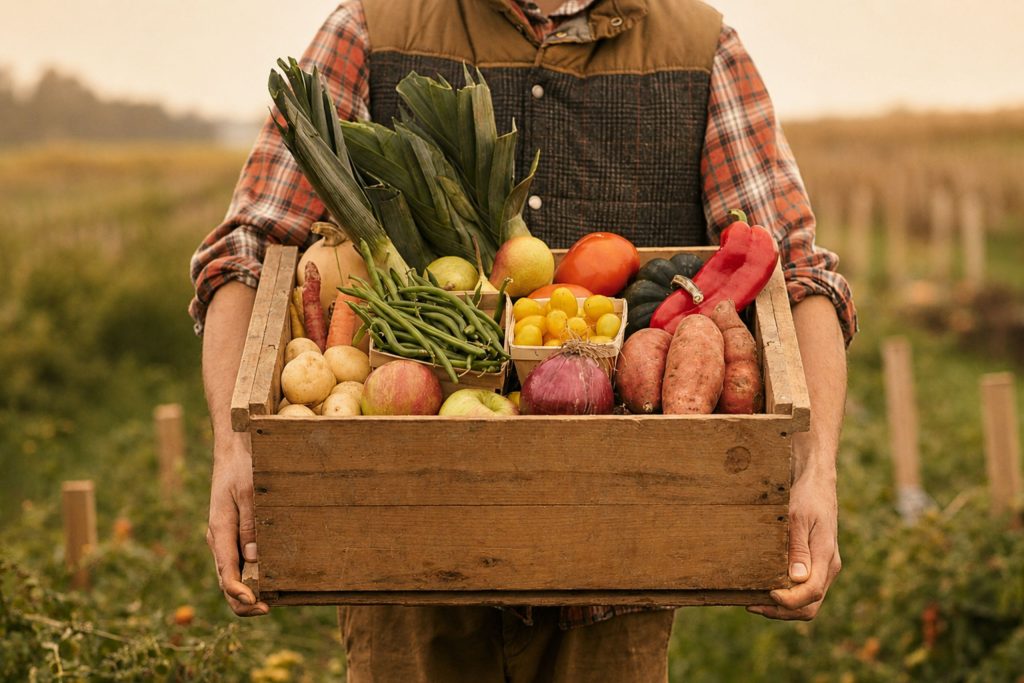
Local sourcing is a supply chain model in which the distance between production and consumption is reduced to a minimum. A locally sourced product is born, raised, or processed close to where it is purchased, cutting down on intermediate steps, transport, and the time between harvest and table.
It’s not just a matter of logistics: it’s also a choice that adds value to the local area, supports local producers, and makes a food’s journey more transparent — from the field (or farm) all the way to the plate.
What is organic
Organic, on the other hand, deals more with the productive method. An organic product is born from a certified process that eliminates all kinds of pesticides and synthetic fertilizers, protects the soil’s fertility, respects the biodiversity and, especially in farms, puts a special attention to animal welfare.
What matters with an organic product is not how far it has travelled to reach the table, but how it was grown, raised, or processed throughout the supply chain.
The differences to be aware of
- Locally sourced and organic are not synonyms, and knowing the differences between them can help making better choices:
- Locally sourced is not always organic: a local product can be grown using conventional methods, which means using chemicals fertilizers.
- Organic is not always locally sourced: an organic product can come from far away, having a high impact linked to its transportation.
Together, the complete each other: only putting together the properties of both of them one can obtain the maximum benefit, both for the consumer and the environment.
Why people talk about a winning combination
Precisely because “locally sourced” and “organic” address two different and complementary needs — knowing where a product comes from and knowing how it was made — bringing them together can be called a winning combination..
On their own, the two elements tell only part of the story: a local product does not in itself guarantee a sustainable production method, just as an organic product does not alone guarantee proximity to the territory. Together, however, they cover both aspects: freshness and connection with the territory on the one hand, respect for the environment and biodiversity on the other. It is this complementarity that makes the combination more complete, and therefore successful, with respect to each of the two characteristics taken individually.
The main advantages of the combination of local and organic production
More freshness and more nutrients
Local products reach the table shortly after harvest or processing. Shorter timeframes between production and consumption help preserve flavor, texture, and nutritional value more effectively.
Less pollution
Reducing the distance, a food travels often means cutting transport-related emissions and relying less on the elaborate packaging designed to withstand long journeys.
No synthetic chemicals
Organic farming and livestock breeding rule out synthetic pesticides and fertilizers, protecting the soil, water, and biodiversity of the ecosystem where the products originate.
A more transparent supply chain
Those who choose zero-km and organic products aren’t just looking for good food, but for a production process they can understand: where it comes from, how it was made, and who was involved.
Why this matter for organic cured meats too?
When it comes to organic cured meats, the relationship between production method and raw material origin becomes especially important. A cured meat product isn’t born only at the processing stage — the quality of the finished product depends on a whole series of earlier factors: animal husbandry, animal feed, raw material selection, supply chain management, processing, curing, and quality control.
For this reason, in the cured meats sector, talking about “organic” necessarily means talking about the supply chain. A certified organic cured meat product isn’t simply something processed according to certain rules — it’s the result of a production system in which agricultural and livestock choices directly affect the quality of the raw material and, consequently, the final product.
In this context, the proximity of the production stages takes on strategic value: it reduces supply chain fragmentation, makes control more direct, and allows for greater consistency between the organic method, the origin of the raw material, and processing.
The Pedrazzoli model: organic and integrated short supply chain
At Salumificio Pedrazzoli, the relationship between “organic” and “local sourcing” is best understood in terms of a short supply chain, direct control over raw materials, and integration between farming, livestock, and food processing activities.
Applied to a production reality like Pedrazzoli, the concept of “zero km” doesn’t simply mean proximity between the finished product and the end consumer — it refers instead to reducing the distance between the strategic stages of the supply chain: agricultural production, livestock farming, raw material selection, and processing.
This approach is especially relevant to the Primavera Bio line, launched in 1996 and developed as a structured organic project within the company.
Why Pedrazzoli can be described as local sourced
For Salumificio Pedrazzoli, talking about locally sourced means referring to a supply chain in which the main activities affecting raw material quality are located within a defined and directly controlled territorial area.
The value of local sourcing here isn’t tied only to reducing transport distances — it’s mainly about the ability to limit supply chain fragmentation and maintain closer control over the stages that precede processing.
From this perspective, “zero km” doesn’t simply mean “local product,” but organizational proximity between land, livestock, raw material, and the meat-processing facility.
FAQ: local sourcing and organic
Are zero km and organic the same thing?
No. “Zero km” refers to the distance between production and consumption, while “organic” refers to the method by which a food is grown, raised, or processed. A product can be local without being organic, or organic without being local: only when the two characteristics come together can we speak of a truly winning combination.
What does “locally sourced cured meat” mean?
For a cured meat product, “zero km” isn’t just about the distance between the point of sale and the consumer — it’s about reducing the distance between the stages that affect raw material quality: livestock farming, cut selection, processing, and curing. The closer and more integrated these stages are, the more traceable and controllable the supply chain becomes.
Is an organic product always also zero km?
No. A food can be certified organic even if it has traveled a long way before reaching the table, with a transport-related impact that is far from negligible. Organic and zero km are independent, though complementary, characteristics.
Why is the Primavera Bio line considered locally sourced?
Because it combines the organic method with a short supply chain: the stages of agricultural production, livestock farming, raw material selection, and processing are located within a defined territorial area directly controlled by Salumificio Pedrazzoli, reducing supply chain fragmentation.